2026
Rippled shock transmission through slow–fast interfaces
J. Fluid Mech. Under-Review
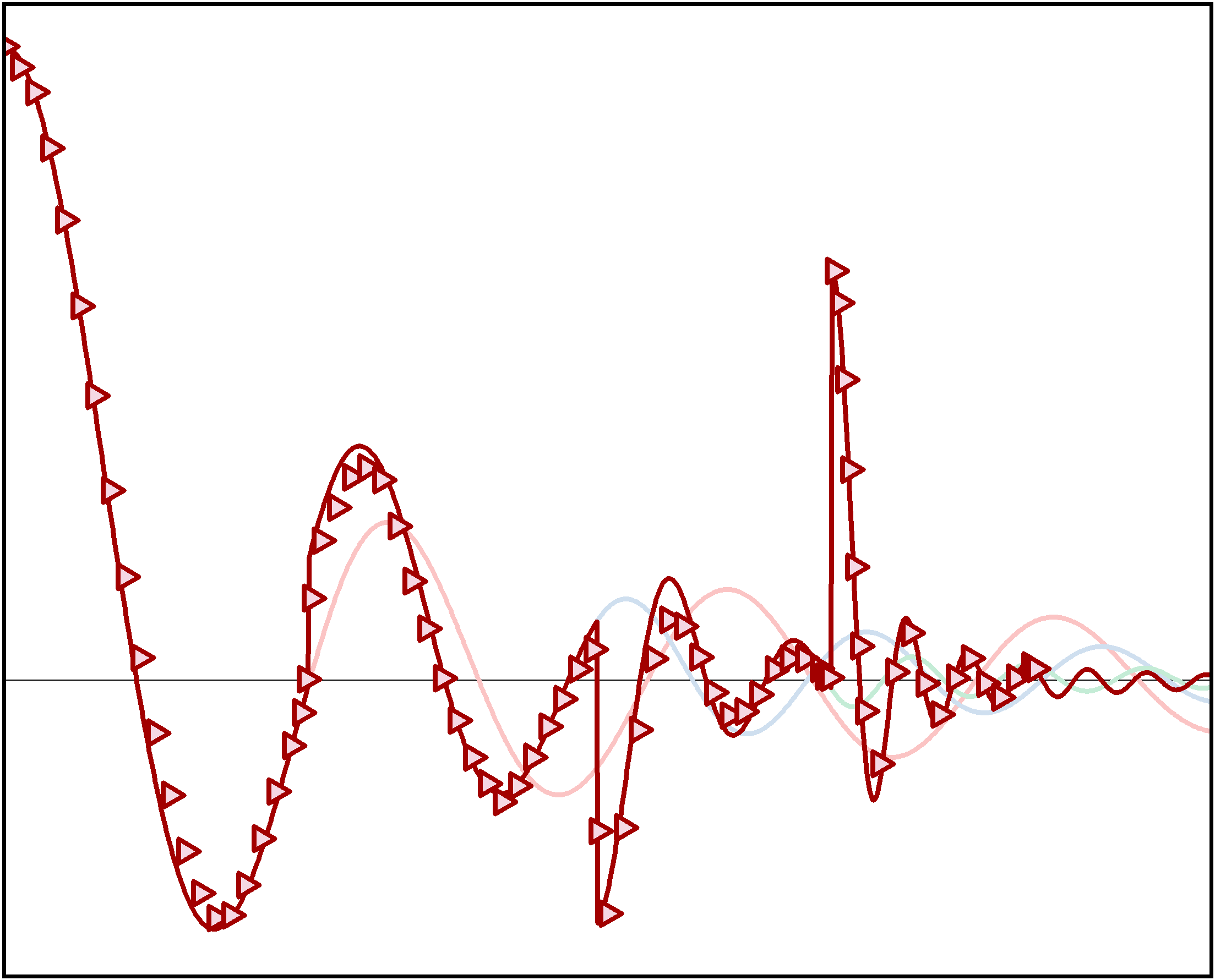
The evolution of a rippled shock transmission through slow--fast interfaces is investigated, considering the phase-dependent initial conditions generated during transmission. A matched solution is first constructed by mapping the transmitted-shock initial amplitude and growth rate to an equivalent isolated-shock evolution, but only provides accurate predictions in the early stage. Then a generalized analytical model is derived by reducing the pressure-perturbation dynamics to the Klein--Gordon equation. The resulting Bessel-series solution retains the even-order terms that vanish in conventional initial-phase formulations, thereby enabling good prediction of transmitted shocks initiated at an arbitrary phase with nonzero initial pressure and normal-velocity perturbations. The results show that although the rippled transmitted shock evolution may be weakly sensitive to the detailed form of the boundary condition, it depends strongly on the relative shock--interface distance through acoustic feedback. Each slow--fast transmission significantly increases both the attenuation rate and the oscillation frequency of the shock-front perturbation. Using the explicit dependence of transmitted-shock initial conditions on the shock--interface parameters, we determine the optimal parameter combinations for suppressing corrugations, enabling active control of transmitted-shock perturbations.
Rippled shock transmission through slow–fast interfaces
J. Fluid Mech. Under-Review
The evolution of a rippled shock transmission through slow--fast interfaces is investigated, considering the phase-dependent initial conditions generated during transmission. A matched solution is first constructed by mapping the transmitted-shock initial amplitude and growth rate to an equivalent isolated-shock evolution, but only provides accurate predictions in the early stage. Then a generalized analytical model is derived by reducing the pressure-perturbation dynamics to the Klein--Gordon equation. The resulting Bessel-series solution retains the even-order terms that vanish in conventional initial-phase formulations, thereby enabling good prediction of transmitted shocks initiated at an arbitrary phase with nonzero initial pressure and normal-velocity perturbations. The results show that although the rippled transmitted shock evolution may be weakly sensitive to the detailed form of the boundary condition, it depends strongly on the relative shock--interface distance through acoustic feedback. Each slow--fast transmission significantly increases both the attenuation rate and the oscillation frequency of the shock-front perturbation. Using the explicit dependence of transmitted-shock initial conditions on the shock--interface parameters, we determine the optimal parameter combinations for suppressing corrugations, enabling active control of transmitted-shock perturbations.
激波诱导重-轻型界面不稳定性研究Heavy–Light Interfacial Instability Induced by Shocks
Ph. D. thesis 2026
Richtmyer–Meshkov(RM)不稳定性是激波与具有初始扰动的流体界面相互作用后产生的典型界面失稳现象,该现象广泛存在于高能量密度物理、天体物理以及惯性约束核聚变(ICF)等科学问题与工程应用中。在ICF点火过程中,激光驱动形成的高强度汇聚激波不可避免地与多模扰动界面相互作用,诱发RM不稳定性并增强燃料掺混,是降低能量增益与制约点火实现的关键因素之一。ICF靶丸内层通常呈重–轻型界面结构;受激光照射不完全对称与触发不同步等因素影响,入射激波扰动及界面扰动均难以避免。相比轻–重型界面,重–轻型界面RM不稳定性的演化规律及其深层机理仍缺乏系统认识。针对激波诱导的重–轻型界面RM不稳定性,本文结合实验、数值模拟与理论建模,重点研究可压缩性效应、模态耦合效应、汇聚几何效应以及扰动入射激波效应的影响规律。 针对传统RM不稳定性实验中固体障碍物对流动与波系干扰这一不足,本文利用超疏水–疏油表面对肥皂膜界面的约束,发展了无需固体障碍物的间断气体界面生成方法,并在多类典型工况下进行了验证。实验与数值对比表明,与传统方法相比,该方法可有效避免由障碍物引入的附加反射波及边界效应,在重–轻型界面、多层界面与较强激波条件下具有更好的适用性。 针对重–轻型界面RM不稳定性的可压缩性效应,开展了不同强度激波冲击单模界面的实验与数值研究,系统评估了若干线性增长率模型的适用范围。基于线性化分析建立了启动阶段模型,阐明了启动阶段与反相阶段的内在联系,并提出更具物理一致性的无量纲参考时刻以归一化振幅增长;进一步揭示了比热比与Atwood数等可压缩物性参数对线性增长特性的影响规律。 针对模态耦合效应,采用奇异摄动法与扰动展开推导了单模与双模界面的匹配渐近展开模态模型,并通过轻–重型与重–轻型界面实验验证了其有效性。该模型能够描述冲击后界面模态振幅的全过程演化,刻画不同基础模态的启动与反相差异,并表明基础模态间耦合不仅影响拍频模态,也会显著作用于非拍频模态。进一步对多模重–轻型界面的气泡与尖钉演化进行分析,发现气泡演化在不同等效波长条件下具有可归一性,而尖钉演化表现出更强的参数敏感性。 针对汇聚几何效应,在开口汇聚激波管中开展了汇聚激波冲击重–轻型单模界面的实验研究,分析了初始振幅波长比、波数等参数对界面演化的影响,并讨论了Bell–Plesset效应与非线性效应在汇聚RM不稳定性中的竞争机制。为改善现有弱非线性模型在较长时间尺度上的适用性,采用Padé 近似对模型进行延展,从而更有效地预测后期振幅演化;并从机理上说明Bell–Plesset效应在汇聚重–轻型界面中促进二次谐波增长、导致气泡发展趋于饱和的作用。 针对扰动入射激波在重–轻型界面上的折射及其后续演化,本文通过求解Klein–Gordon方程建立了扰动透射激波的解析理论,并在单次与多次折射条件下得到验证;在此基础上提出了可显著削弱透射激波扰动的激波–界面参数组合。进一步研究了扰动激波诱导的非标准RM不稳定性,建立了不含经验参数的解析线性模型并通过数值模拟验证。结果表明,随马赫数增大,非标准RM不稳定性的失稳加速程度强于经典RM不稳定性;其关键差异在于波后横向压力梯度引入额外的环量沉积机制。基于所建理论,提出了可显著抑制扰动增长并实现“扰动冻结”的激波与界面扰动组合条件,为非标准RM不稳定性的调控提供理论依据。 Richtmyer–Meshkov (RM) instability is a canonical interfacial instability that arises when a shock interacts with a fluid interface containing initial perturbations. It is ubiquitous in high-energy-density physics, astrophysics, and engineering applications such as inertial confinement fusion (ICF). During the ICF ignition process, intense convergent shocks driven by laser irradiation inevitably interact with interfaces containing multi-mode perturbations, triggering RM instability and enhancing fuel mixing, which constitutes one of the key factors limiting energy gain and ignition success. The inner interfaces of ICF capsules are typically characterized by a heavy–light configuration. Owing to laser asymmetries and timing jitter, both incident shock perturbations and interfacial perturbations are unavoidable. Compared with the light–heavy configuration, the evolution characteristics and underlying physical mechanisms of RM instability at heavy–light interfaces remain insufficiently understood. Focusing on shock-induced RM instability at heavy–light interfaces, this dissertation combines experimental investigations, numerical simulations, and theoretical modeling to systematically study the roles of compressibility effects, mode coupling effects, geometrical convergence effects, and perturbed incident shock effects. To overcome the limitations of traditional RM instability experiments in which solid obstacles introduce flow perturbations and complex wave interactions, a novel method for generating discontinuous gaseous interfaces without solid obstacles is developed by confining soap-film interfaces with super-hydrophobic–oleophobic surfaces. This method is validated under several representative experimental conditions. Comparisons between experiments and numerical simulations demonstrate that the proposed approach effectively eliminates additional reflected waves and boundary effects induced by solid obstacles, and exhibits superior applicability compared with conventional methods, particularly for heavy–light interfaces, multilayer interfaces, and strong shock conditions. To investigate compressibility effects in RM instability at heavy–light interfaces, systematic experimental and numerical studies are conducted for single-mode interfaces subjected to shocks of varying strengths. The applicability of several linear growth-rate models is critically assessed. Based on linearized analysis, a startup-process model is established to elucidate the intrinsic connection between the startup stage and the phase-inversion stage. A more physically consistent non-dimensional reference time is proposed for normalizing amplitude growth. Furthermore, the influence of compressibility-related physical properties, such as the specific heat ratio and the Atwood number, on linear growth characteristics is elucidated. To address mode coupling effects, mode evolution models based on the method of matched asymptotic expansions for single- and dual-mode interfaces are derived using singular perturbation methods combined with perturbation expansion methods, and are validated through experiments on both light–heavy and heavy–light interfaces. The proposed model captures the complete post-shock evolution of interfacial mode amplitudes, characterizes the differences in startup and phase-inversion behaviors among different fundamental modes, and demonstrates that mode coupling affects not only beat modes but also non-beat modes. Further analysis of bubble and spike evolution in multi-mode heavy–light interfaces reveals that bubble growth collapses onto a common trend after normalization under different effective wavelengths, whereas spike growth shows stronger sensitivity to initial parameters. To investigate geometrical convergence effects, experiments are conducted in an open-end convergent shock tube, where convergent shocks interact with single-mode heavy–light interfaces. The influences of initial amplitude-to-wavelength ratio and wavenumber on interfacial evolution are analyzed, and the competing roles of the Bell–Plesset effect and nonlinear effects in convergent RM instability are discussed. To improve the applicability of existing weakly nonlinear models over extended timescales, the models are extended using Padé approximation, enabling more accurate prediction of late-time amplitude evolution. The results indicate that the Bell–Plesset effect in convergent heavy–light interfaces promotes the growth of secondary harmonics, leading to saturation tendencies in bubble development. For the refraction and subsequent evolution of perturbed incident shocks at heavy–light interfaces, an analytical theory for perturbed transmitted shocks is established by solving the Klein–Gordon equation, and is validated under both single and multiple refraction conditions. Based on this theory, combinations of shock and interface parameters that can significantly suppress transmitted shock perturbations are identified. Furthermore, non-standard RM instability induced by perturbed shocks is investigated, and an analytical linear model free of empirical parameters is developed and validated through numerical simulations. The results indicate that, with increasing Mach number, the growth of non-standard RM instability accelerates more strongly than that of classical RM instability. This fundamental difference is attributed to an additional circulation deposition mechanism introduced by transverse pressure gradients in the post-shock flow. Based on the developed theory, combinations of shock and interface perturbations capable of substantially suppressing perturbation growth and achieving “perturbation freeze-out” are identified, providing a theoretical foundation for the manipulation of non-standard RM instability.
激波诱导重-轻型界面不稳定性研究Heavy–Light Interfacial Instability Induced by Shocks
Ph. D. thesis 2026
Richtmyer–Meshkov(RM)不稳定性是激波与具有初始扰动的流体界面相互作用后产生的典型界面失稳现象,该现象广泛存在于高能量密度物理、天体物理以及惯性约束核聚变(ICF)等科学问题与工程应用中。在ICF点火过程中,激光驱动形成的高强度汇聚激波不可避免地与多模扰动界面相互作用,诱发RM不稳定性并增强燃料掺混,是降低能量增益与制约点火实现的关键因素之一。ICF靶丸内层通常呈重–轻型界面结构;受激光照射不完全对称与触发不同步等因素影响,入射激波扰动及界面扰动均难以避免。相比轻–重型界面,重–轻型界面RM不稳定性的演化规律及其深层机理仍缺乏系统认识。针对激波诱导的重–轻型界面RM不稳定性,本文结合实验、数值模拟与理论建模,重点研究可压缩性效应、模态耦合效应、汇聚几何效应以及扰动入射激波效应的影响规律。 针对传统RM不稳定性实验中固体障碍物对流动与波系干扰这一不足,本文利用超疏水–疏油表面对肥皂膜界面的约束,发展了无需固体障碍物的间断气体界面生成方法,并在多类典型工况下进行了验证。实验与数值对比表明,与传统方法相比,该方法可有效避免由障碍物引入的附加反射波及边界效应,在重–轻型界面、多层界面与较强激波条件下具有更好的适用性。 针对重–轻型界面RM不稳定性的可压缩性效应,开展了不同强度激波冲击单模界面的实验与数值研究,系统评估了若干线性增长率模型的适用范围。基于线性化分析建立了启动阶段模型,阐明了启动阶段与反相阶段的内在联系,并提出更具物理一致性的无量纲参考时刻以归一化振幅增长;进一步揭示了比热比与Atwood数等可压缩物性参数对线性增长特性的影响规律。 针对模态耦合效应,采用奇异摄动法与扰动展开推导了单模与双模界面的匹配渐近展开模态模型,并通过轻–重型与重–轻型界面实验验证了其有效性。该模型能够描述冲击后界面模态振幅的全过程演化,刻画不同基础模态的启动与反相差异,并表明基础模态间耦合不仅影响拍频模态,也会显著作用于非拍频模态。进一步对多模重–轻型界面的气泡与尖钉演化进行分析,发现气泡演化在不同等效波长条件下具有可归一性,而尖钉演化表现出更强的参数敏感性。 针对汇聚几何效应,在开口汇聚激波管中开展了汇聚激波冲击重–轻型单模界面的实验研究,分析了初始振幅波长比、波数等参数对界面演化的影响,并讨论了Bell–Plesset效应与非线性效应在汇聚RM不稳定性中的竞争机制。为改善现有弱非线性模型在较长时间尺度上的适用性,采用Padé 近似对模型进行延展,从而更有效地预测后期振幅演化;并从机理上说明Bell–Plesset效应在汇聚重–轻型界面中促进二次谐波增长、导致气泡发展趋于饱和的作用。 针对扰动入射激波在重–轻型界面上的折射及其后续演化,本文通过求解Klein–Gordon方程建立了扰动透射激波的解析理论,并在单次与多次折射条件下得到验证;在此基础上提出了可显著削弱透射激波扰动的激波–界面参数组合。进一步研究了扰动激波诱导的非标准RM不稳定性,建立了不含经验参数的解析线性模型并通过数值模拟验证。结果表明,随马赫数增大,非标准RM不稳定性的失稳加速程度强于经典RM不稳定性;其关键差异在于波后横向压力梯度引入额外的环量沉积机制。基于所建理论,提出了可显著抑制扰动增长并实现“扰动冻结”的激波与界面扰动组合条件,为非标准RM不稳定性的调控提供理论依据。 Richtmyer–Meshkov (RM) instability is a canonical interfacial instability that arises when a shock interacts with a fluid interface containing initial perturbations. It is ubiquitous in high-energy-density physics, astrophysics, and engineering applications such as inertial confinement fusion (ICF). During the ICF ignition process, intense convergent shocks driven by laser irradiation inevitably interact with interfaces containing multi-mode perturbations, triggering RM instability and enhancing fuel mixing, which constitutes one of the key factors limiting energy gain and ignition success. The inner interfaces of ICF capsules are typically characterized by a heavy–light configuration. Owing to laser asymmetries and timing jitter, both incident shock perturbations and interfacial perturbations are unavoidable. Compared with the light–heavy configuration, the evolution characteristics and underlying physical mechanisms of RM instability at heavy–light interfaces remain insufficiently understood. Focusing on shock-induced RM instability at heavy–light interfaces, this dissertation combines experimental investigations, numerical simulations, and theoretical modeling to systematically study the roles of compressibility effects, mode coupling effects, geometrical convergence effects, and perturbed incident shock effects. To overcome the limitations of traditional RM instability experiments in which solid obstacles introduce flow perturbations and complex wave interactions, a novel method for generating discontinuous gaseous interfaces without solid obstacles is developed by confining soap-film interfaces with super-hydrophobic–oleophobic surfaces. This method is validated under several representative experimental conditions. Comparisons between experiments and numerical simulations demonstrate that the proposed approach effectively eliminates additional reflected waves and boundary effects induced by solid obstacles, and exhibits superior applicability compared with conventional methods, particularly for heavy–light interfaces, multilayer interfaces, and strong shock conditions. To investigate compressibility effects in RM instability at heavy–light interfaces, systematic experimental and numerical studies are conducted for single-mode interfaces subjected to shocks of varying strengths. The applicability of several linear growth-rate models is critically assessed. Based on linearized analysis, a startup-process model is established to elucidate the intrinsic connection between the startup stage and the phase-inversion stage. A more physically consistent non-dimensional reference time is proposed for normalizing amplitude growth. Furthermore, the influence of compressibility-related physical properties, such as the specific heat ratio and the Atwood number, on linear growth characteristics is elucidated. To address mode coupling effects, mode evolution models based on the method of matched asymptotic expansions for single- and dual-mode interfaces are derived using singular perturbation methods combined with perturbation expansion methods, and are validated through experiments on both light–heavy and heavy–light interfaces. The proposed model captures the complete post-shock evolution of interfacial mode amplitudes, characterizes the differences in startup and phase-inversion behaviors among different fundamental modes, and demonstrates that mode coupling affects not only beat modes but also non-beat modes. Further analysis of bubble and spike evolution in multi-mode heavy–light interfaces reveals that bubble growth collapses onto a common trend after normalization under different effective wavelengths, whereas spike growth shows stronger sensitivity to initial parameters. To investigate geometrical convergence effects, experiments are conducted in an open-end convergent shock tube, where convergent shocks interact with single-mode heavy–light interfaces. The influences of initial amplitude-to-wavelength ratio and wavenumber on interfacial evolution are analyzed, and the competing roles of the Bell–Plesset effect and nonlinear effects in convergent RM instability are discussed. To improve the applicability of existing weakly nonlinear models over extended timescales, the models are extended using Padé approximation, enabling more accurate prediction of late-time amplitude evolution. The results indicate that the Bell–Plesset effect in convergent heavy–light interfaces promotes the growth of secondary harmonics, leading to saturation tendencies in bubble development. For the refraction and subsequent evolution of perturbed incident shocks at heavy–light interfaces, an analytical theory for perturbed transmitted shocks is established by solving the Klein–Gordon equation, and is validated under both single and multiple refraction conditions. Based on this theory, combinations of shock and interface parameters that can significantly suppress transmitted shock perturbations are identified. Furthermore, non-standard RM instability induced by perturbed shocks is investigated, and an analytical linear model free of empirical parameters is developed and validated through numerical simulations. The results indicate that, with increasing Mach number, the growth of non-standard RM instability accelerates more strongly than that of classical RM instability. This fundamental difference is attributed to an additional circulation deposition mechanism introduced by transverse pressure gradients in the post-shock flow. Based on the developed theory, combinations of shock and interface perturbations capable of substantially suppressing perturbation growth and achieving “perturbation freeze-out” are identified, providing a theoretical foundation for the manipulation of non-standard RM instability.
Atwood-number dependence of the instability evolution at a shock-accelerated heavy fluid layer
Chenren Chen, Jiaxuan Li, Zhigang Zhai
J. Fluid Mech. 2026
Numerical simulations and theoretical analysis are conducted to investigate the Atwood-number dependence of perturbation evolution in a shocked heavy fluid layer. For layers without reverberating waves, a higher Atwood number of one interface significantly enhances its coupling effect on the perturbation growth at the opposite interface. A theoretical model incorporating the startup, linear and nonlinear stages is developed to predict the interface mixing width. Dimensionless formulae are derived, identifying eight distinct modulation regimes of multi-interface instability.
Atwood-number dependence of the instability evolution at a shock-accelerated heavy fluid layer
Chenren Chen, Jiaxuan Li, Zhigang Zhai
J. Fluid Mech. 2026
Numerical simulations and theoretical analysis are conducted to investigate the Atwood-number dependence of perturbation evolution in a shocked heavy fluid layer. For layers without reverberating waves, a higher Atwood number of one interface significantly enhances its coupling effect on the perturbation growth at the opposite interface. A theoretical model incorporating the startup, linear and nonlinear stages is developed to predict the interface mixing width. Dimensionless formulae are derived, identifying eight distinct modulation regimes of multi-interface instability.
2025

Modelling and mechanism of non-standard Richtmyer-Meshkov instability at heavy-light interfaces under moderate Mach numbers
J. Fluid Mech. 2025 Newest-work
This study presents an analytical advancement in predicting the growth rate of perturbation amplitude in two-dimensional non-standard Richtmyer-Meshkov instability (RMI), driven by the interaction of a first-phase rippled shock wave at moderate Mach number with a heavy-light interface. We extend the irrotational model to encompass non-standard RMI scenarios, establishing a generalized framework validated through numerical simulations. Distinct from previous models, our model is free of empirical coefficients, and demonstrates superior accuracy across diverse perturbation configurations and Mach numbers. The analyses reveal the fundamental disparity of non-standard RMI from classical RMI: the vorticity deposition mechanism in non-standard RMI arises not only from normal pressure gradients at the shock front but crucially from tangential pressure gradients behind the shock wave. The asymptotic circulations are also well predicted by our model. Moreover, the relationship of the amplitudes between sinusoidal shock and perturbed interface is derived based on the model to realize the freeze-out of interface amplitude. The initial fundamental mode's amplitude growth is frozen well, and the mixing width is greatly suppressed.
Modelling and mechanism of non-standard Richtmyer-Meshkov instability at heavy-light interfaces under moderate Mach numbers
J. Fluid Mech. 2025 Newest-work
This study presents an analytical advancement in predicting the growth rate of perturbation amplitude in two-dimensional non-standard Richtmyer-Meshkov instability (RMI), driven by the interaction of a first-phase rippled shock wave at moderate Mach number with a heavy-light interface. We extend the irrotational model to encompass non-standard RMI scenarios, establishing a generalized framework validated through numerical simulations. Distinct from previous models, our model is free of empirical coefficients, and demonstrates superior accuracy across diverse perturbation configurations and Mach numbers. The analyses reveal the fundamental disparity of non-standard RMI from classical RMI: the vorticity deposition mechanism in non-standard RMI arises not only from normal pressure gradients at the shock front but crucially from tangential pressure gradients behind the shock wave. The asymptotic circulations are also well predicted by our model. Moreover, the relationship of the amplitudes between sinusoidal shock and perturbed interface is derived based on the model to realize the freeze-out of interface amplitude. The initial fundamental mode's amplitude growth is frozen well, and the mixing width is greatly suppressed.
Atwood-number dependence of the Richtmyer–Meshkov instability at a heavy–light single-mode interface
Yinuo Xing, Chenren Chen, Jiaxuan Li, He Wang, Zhigang Zhai, Xisheng Luo
J. Fluid Mech. 2025
The dependence of the Richtmyer–Meshkov instability (RMI) on post-shock Atwood number ($|A_1|$) is experimentally investigated for a heavy–light single-mode interface. We create initial interfaces with density ratios of heavy to light gases ranging from 1.73 to 34.07, and achieve the highest $|A_1|$ value reported to date for gaseous-interface experiments (0.95).
Atwood-number dependence of the Richtmyer–Meshkov instability at a heavy–light single-mode interface
Yinuo Xing, Chenren Chen, Jiaxuan Li, He Wang, Zhigang Zhai, Xisheng Luo
J. Fluid Mech. 2025
The dependence of the Richtmyer–Meshkov instability (RMI) on post-shock Atwood number ($|A_1|$) is experimentally investigated for a heavy–light single-mode interface. We create initial interfaces with density ratios of heavy to light gases ranging from 1.73 to 34.07, and achieve the highest $|A_1|$ value reported to date for gaseous-interface experiments (0.95).
Attenuation of Richtmyer-Meshkov instability growth of fluid layer via double shock
Chenren Chen, Jiaxuan Li, Zhigang Zhai, Xisheng Luo
Sci. China-Phys. Mech. Astron. 2025
Suppression of the hydrodynamic instabilities involved in the inertial confinement fusion has attracted much attention but remains a challenge. In this work, we report the first theoretical analysis and experimental validation on attenuating the instability growth of a shock-accelerated fluid layer through a second shock impact.
Attenuation of Richtmyer-Meshkov instability growth of fluid layer via double shock
Chenren Chen, Jiaxuan Li, Zhigang Zhai, Xisheng Luo
Sci. China-Phys. Mech. Astron. 2025
Suppression of the hydrodynamic instabilities involved in the inertial confinement fusion has attracted much attention but remains a challenge. In this work, we report the first theoretical analysis and experimental validation on attenuating the instability growth of a shock-accelerated fluid layer through a second shock impact.
Manipulation of Richtmyer–Meshkov instability on a heavy–light interface via successive shocks
Zhigang Zhai, Chenren Chen, Yinuo Xing, Jiaxuan Li, Qing Cao, He Wang, Xisheng Luo
J. Fluid Mech. 2025
The manipulation of the Richtmyer–Meshkov instability growth at a heavy–light interface via successive shocks is theoretically analysed and experimentally realized in a specific shock-tube facility.
Manipulation of Richtmyer–Meshkov instability on a heavy–light interface via successive shocks
Zhigang Zhai, Chenren Chen, Yinuo Xing, Jiaxuan Li, Qing Cao, He Wang, Xisheng Luo
J. Fluid Mech. 2025
The manipulation of the Richtmyer–Meshkov instability growth at a heavy–light interface via successive shocks is theoretically analysed and experimentally realized in a specific shock-tube facility.
2024

Asymptotic matching modal model on Richtmyer–Meshkov instability
Jiaxuan Li, Chenren Chen, Zhigang Zhai, Xisheng Luo
J. Fluid Mech. 2025 Spotlight
An asymptotic matching modal model is established based on the singular perturbation method for predicting mode evolution in single- and dual-mode interfaces accelerated by a shock wave. The startup process is incorporated into the model to provide a complete description of the mode evolution after the shock impact. Through considering the feedback from high-order harmonic to the third-order harmonic, the model accuracy is improved and the model divergence is prevented. In addition, the model can evaluate the mutual-coupling effect on the amplitude variations of high-order harmonics besides the ‘beat modes’. To validate the model, experiments on both light–heavy and heavy–light interfaces subject to a shock wave are conducted, and both single- and dual-mode interfaces formed by the soap-film technique are involved. The interface profiles extracted from mode decomposition and predicted by the model show high consistency with the experimental counterparts. Good agreement of the mode amplitude growths between the experiments and theoretical predictions shows the superiority of the model, especially for the heavy–light interface.
Asymptotic matching modal model on Richtmyer–Meshkov instability
Jiaxuan Li, Chenren Chen, Zhigang Zhai, Xisheng Luo
J. Fluid Mech. 2025 Spotlight
An asymptotic matching modal model is established based on the singular perturbation method for predicting mode evolution in single- and dual-mode interfaces accelerated by a shock wave. The startup process is incorporated into the model to provide a complete description of the mode evolution after the shock impact. Through considering the feedback from high-order harmonic to the third-order harmonic, the model accuracy is improved and the model divergence is prevented. In addition, the model can evaluate the mutual-coupling effect on the amplitude variations of high-order harmonics besides the ‘beat modes’. To validate the model, experiments on both light–heavy and heavy–light interfaces subject to a shock wave are conducted, and both single- and dual-mode interfaces formed by the soap-film technique are involved. The interface profiles extracted from mode decomposition and predicted by the model show high consistency with the experimental counterparts. Good agreement of the mode amplitude growths between the experiments and theoretical predictions shows the superiority of the model, especially for the heavy–light interface.
Coupled Richtmyer–Meshkov and Kelvin–Helmholtz instability on a shock-accelerated inclined single-mode interface
Qing Cao, Jiaxuan Li, He Wang, Zhigang Zhai, Xisheng Luo
J. Fluid Mech. 2024
The coupling of Richtmyer–Meshkov instability (RMI) and Kelvin–Helmholtz instability (KHI), referred to as RM-KHI, on a shock-accelerated inclined single-mode air–SF$_6$ interface is studied through shock-tube experiments, focusing on the evolution of the perturbation distributed along the inclined interface.
Coupled Richtmyer–Meshkov and Kelvin–Helmholtz instability on a shock-accelerated inclined single-mode interface
Qing Cao, Jiaxuan Li, He Wang, Zhigang Zhai, Xisheng Luo
J. Fluid Mech. 2024
The coupling of Richtmyer–Meshkov instability (RMI) and Kelvin–Helmholtz instability (KHI), referred to as RM-KHI, on a shock-accelerated inclined single-mode air–SF$_6$ interface is studied through shock-tube experiments, focusing on the evolution of the perturbation distributed along the inclined interface.
Effects of disturbed transmitted shock and interface coupling on heavy gas layer evolution
Chenren Chen, Jiaxuan Li, Zhigang Zhai, Xisheng Luo
Phys. Fluids 2024
Development of a heavy gas layer with an upstream single-mode interface and a downstream planar interface accelerated by a shock wave is investigated. By considering the amplitude variation of the transmitted shock and interface coupling, a modified model is established, which provides good predictions on the linear growth rates of the perturbations on both interfaces.
Effects of disturbed transmitted shock and interface coupling on heavy gas layer evolution
Chenren Chen, Jiaxuan Li, Zhigang Zhai, Xisheng Luo
Phys. Fluids 2024
Development of a heavy gas layer with an upstream single-mode interface and a downstream planar interface accelerated by a shock wave is investigated. By considering the amplitude variation of the transmitted shock and interface coupling, a modified model is established, which provides good predictions on the linear growth rates of the perturbations on both interfaces.
Effects of compressibility on Richtmyer–Meshkov instability of heavy/light interface
Jiaxuan Li, Chenren Chen, Zhigang Zhai, Xisheng Luo
Phys. Fluids 2024
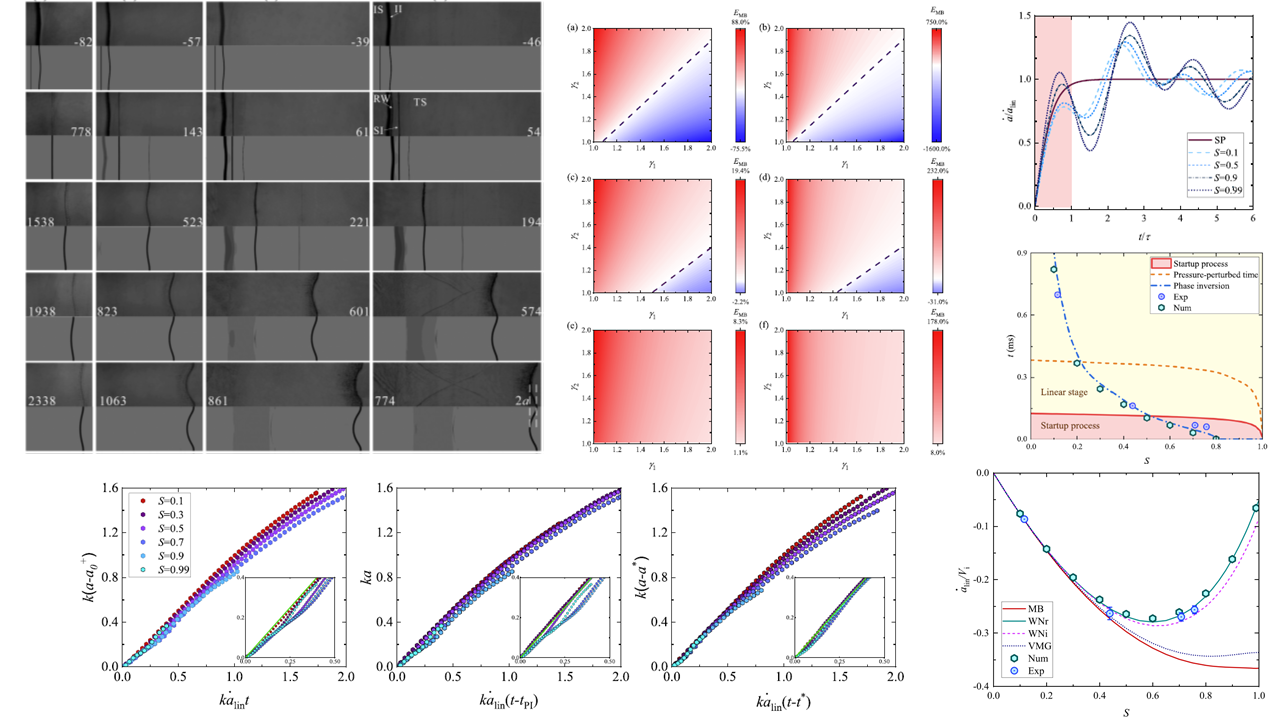
Experimental and numerical studies on the evolution of shock-accelerated SF$_6$/air interface with small initial amplitude are conducted. The effect of compressibility on the early development of perturbation is highlighted by varying shock intensity and fluid properties. The startup process is analyzed when rarefaction waves are reflected and the characteristic time of the startup process is provided. The relationship between the phase inversion process and the startup process under different incident shock strengths is clarified. According to the startup time, a new start point for normalization is given, which can better normalize the amplitude growth at the early stage. In addition, the effects of incident shock strength and physical properties of fluids on the linear growth rate are highlighted through numerical simulations. The incompressible linear model loses validity when the incident shock is strong, and the existing rotational model is verified to provide excellent predictions under any shock strengths. The decrease in adiabatic exponent of the heavy fluid or the increase in adiabatic exponent of the light fluid can reduce the linear growth rate. As the absolute value of Atwood number increases, the adiabatic exponent of the heavy fluid has a more significant effect on the linear growth than that of the light fluid..
Effects of compressibility on Richtmyer–Meshkov instability of heavy/light interface
Jiaxuan Li, Chenren Chen, Zhigang Zhai, Xisheng Luo
Phys. Fluids 2024
Experimental and numerical studies on the evolution of shock-accelerated SF$_6$/air interface with small initial amplitude are conducted. The effect of compressibility on the early development of perturbation is highlighted by varying shock intensity and fluid properties. The startup process is analyzed when rarefaction waves are reflected and the characteristic time of the startup process is provided. The relationship between the phase inversion process and the startup process under different incident shock strengths is clarified. According to the startup time, a new start point for normalization is given, which can better normalize the amplitude growth at the early stage. In addition, the effects of incident shock strength and physical properties of fluids on the linear growth rate are highlighted through numerical simulations. The incompressible linear model loses validity when the incident shock is strong, and the existing rotational model is verified to provide excellent predictions under any shock strengths. The decrease in adiabatic exponent of the heavy fluid or the increase in adiabatic exponent of the light fluid can reduce the linear growth rate. As the absolute value of Atwood number increases, the adiabatic exponent of the heavy fluid has a more significant effect on the linear growth than that of the light fluid..
2023

Richtmyer–Meshkov instability of a single-mode heavy–light interface in cylindrical geometry
Jiaxuan Li, He Wang, Zhigang Zhai, Xisheng Luo
Phys. Fluids 2023
Richtmyer–Meshkov (RM) instability of a single-mode SF$_6$–air interface subjected to a convergent shock is investigated experimentally. The convergent shock tube is specially designed with an opening tail to weaken the Rayleigh–Taylor effect and eliminate the reflected waves' effect. The gas layer scheme is used to create a heavy gas environment at the upstream side of the interface. Before phase inversion is finished, the amplitude reduction is accelerated, but the Bell–Plesset (BP) effect in this process is found to be negligible. After phase inversion is completed, the linear growth rate is generally predicted due to small amplitude and the weak BP effect. In nonlinear regime, an existing nonlinear model is revised based on the Padé approximation to give a better prediction of amplitude growth. The spike amplitude grows almost linearly, whereas the bubble amplitude gradually saturates and even reduces. For a heavy-light interface in convergent geometry, although both the spike and bubble amplitude growths are promoted by the BP effect, the spike growth is more promoted than the bubble. The BP effect enhances generation of the second-order harmonic, which results in saturation and reduction of the bubble amplitude. The discrepancy in the BP effect between light-heavy and heavy-light interfaces is qualitatively demonstrated for the first time.
Richtmyer–Meshkov instability of a single-mode heavy–light interface in cylindrical geometry
Jiaxuan Li, He Wang, Zhigang Zhai, Xisheng Luo
Phys. Fluids 2023
Richtmyer–Meshkov (RM) instability of a single-mode SF$_6$–air interface subjected to a convergent shock is investigated experimentally. The convergent shock tube is specially designed with an opening tail to weaken the Rayleigh–Taylor effect and eliminate the reflected waves' effect. The gas layer scheme is used to create a heavy gas environment at the upstream side of the interface. Before phase inversion is finished, the amplitude reduction is accelerated, but the Bell–Plesset (BP) effect in this process is found to be negligible. After phase inversion is completed, the linear growth rate is generally predicted due to small amplitude and the weak BP effect. In nonlinear regime, an existing nonlinear model is revised based on the Padé approximation to give a better prediction of amplitude growth. The spike amplitude grows almost linearly, whereas the bubble amplitude gradually saturates and even reduces. For a heavy-light interface in convergent geometry, although both the spike and bubble amplitude growths are promoted by the BP effect, the spike growth is more promoted than the bubble. The BP effect enhances generation of the second-order harmonic, which results in saturation and reduction of the bubble amplitude. The discrepancy in the BP effect between light-heavy and heavy-light interfaces is qualitatively demonstrated for the first time.
New interface formation method for shock–interface interaction studies
Jiaxuan Li, Qing Cao, He Wang, Zhigang Zhai, Xisheng Luo
Exp. Fluids 2023 My-Favorite-Work
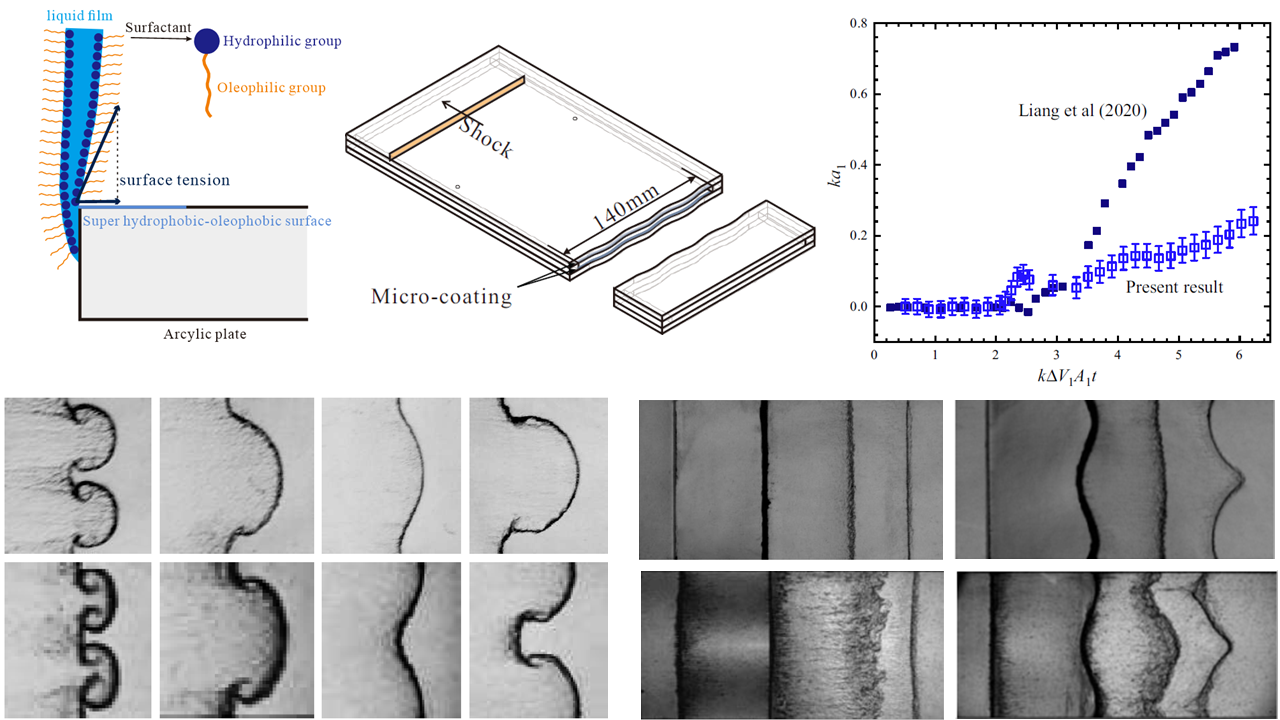
We propose a new interface formation method for shock–interface interaction studies by using the super-hydrophobic–oleophobic surface instead of filaments to constrain the soap–film interface. To verify this method, developments of a single-mode air–SFinterface and a heavy gas layer accelerated by shock waves are experimentally investigated and compared with the previous studies. For single-mode interface developments, experimental schlieren images show that the interfaces are more fully developed, and the thickness of the interface profile reduces more than 60%. For shock-induced heavy gas layer instability, the interface profile is more distinct, and the mixing width of the upstream interface after it passes through the initial position of the downstream interface is largely weakened. Quantitative comparison shows that the filaments used to constrain the soap–film interface have a significant effect on the movement and amplitude growth of the upstream interface, and the superiority of the present method is well demonstrated.
New interface formation method for shock–interface interaction studies
Jiaxuan Li, Qing Cao, He Wang, Zhigang Zhai, Xisheng Luo
Exp. Fluids 2023 My-Favorite-Work
We propose a new interface formation method for shock–interface interaction studies by using the super-hydrophobic–oleophobic surface instead of filaments to constrain the soap–film interface. To verify this method, developments of a single-mode air–SFinterface and a heavy gas layer accelerated by shock waves are experimentally investigated and compared with the previous studies. For single-mode interface developments, experimental schlieren images show that the interfaces are more fully developed, and the thickness of the interface profile reduces more than 60%. For shock-induced heavy gas layer instability, the interface profile is more distinct, and the mixing width of the upstream interface after it passes through the initial position of the downstream interface is largely weakened. Quantitative comparison shows that the filaments used to constrain the soap–film interface have a significant effect on the movement and amplitude growth of the upstream interface, and the superiority of the present method is well demonstrated.